Ask the room before you send it.
Paste a line, an offer or a price change and hear how twenty of your customers take it — in three minutes. Then put the same question to a room of specialists in pricing, brand, operations, support, growth and risk, who have to disagree in writing before they make a call. When a decision matters, Outweigh keeps the record and scores it later.
Pricing · Proposition · Campaigns · Retention · Competitive response · Customer Experience
Annual licence from €12,000, unlimited decisions. See what that covers
Operated by Probity Net Limited, registered in Ireland. Platform data is held in the European Union, and every client organisation is isolated from the others. Trust centre
We publish the error, including the misses.
Blind, single-pass runs against outcomes already on the public record. Grounding stops at the decision date, the prediction is frozen before the observed value is read, and no case is removed once it has been scored.
See the protocol and every caseReading the numbers. Mean absolute error is the average distance between the frozen prediction and the observed result, in percentage points. A 12.6 means a typical prediction of 40 per cent landed somewhere near 40 plus or minus about 13. Bias shows the direction it tends to lean, and r shows whether it ranks options in the right order. Read them as error bands on a small set, not as guarantees.
12.6pts MAE
- Cases
- 48
- Bias
- +8.7
- r
- 0.85
Post-cutoff questions the platform had never seen. The honest generalisation number.
8.7pts MAE
- Cases
- 19
- Bias
- +4.1
- r
- 0.93
Ireland and Britain, the question types clients actually ask. Small set — read as indicative.
The decision doesn't disappear when the meeting ends.
Most customer decisions leave nothing behind: a deck, a debate, a result nobody connects back. Outweigh keeps the whole chain intact, so every decision your organisation makes adds to something that compounds.
Because predictions are frozen and outcomes are recorded, the platform can tell you how wrong it has been for you — by audience, by market, and over time. That error band is your organisation's, built from your decisions, and it is never pooled with another client's record.
- Decision12 Mar
Replace the paper stamp card with a digital loyalty programme?
- What we knew12 Mar
Visit behaviour, customer feedback, market research on loyalty adoption.
- Options compared13 Mar
Three versions put to the same panel. Automatic enrolment leads; the other two are too close to separate.
- What we expected14 MarSealed
Sign-up friction is the main barrier for occasional customers.
- What happened26 Jun
Sign-ups rose after removing the app download step.
- What we learned26 Jun
Effort at sign-up mattered more than the size of the reward.
From a question to a scored decision.
The Decision Council is the readable surface of a structured affected-group model, not the product itself. Four steps, no setup.
Visit behaviour
Own transaction records
Customer feedback
Complaints and reviews
Market research
Published loyalty study
- EmmaDaily commuterPositive
“Make it automatic and I'd use it.”
- DanielLoyal regularNeutral
“I already come here most days.”
- MayaOccasional customerSceptical
“Let me join without downloading anything.”
- 01
Tell Outweigh what you're considering
Plain language. No setup.
- 02
Outweigh assembles the context
Your evidence, relevant market evidence and affected customer perspectives.
- 03
Challenge the decision
Hear agreement, disagreement, evidence gaps and what should be tested.
- 04
Compare the options
Several options judged by the same panel, ranked — or told plainly when two are too close to separate.
- 05
Freeze and score it
The prediction is sealed before the outcome is known, then compared with what happened.
Layer two, in practice: the Decision Council
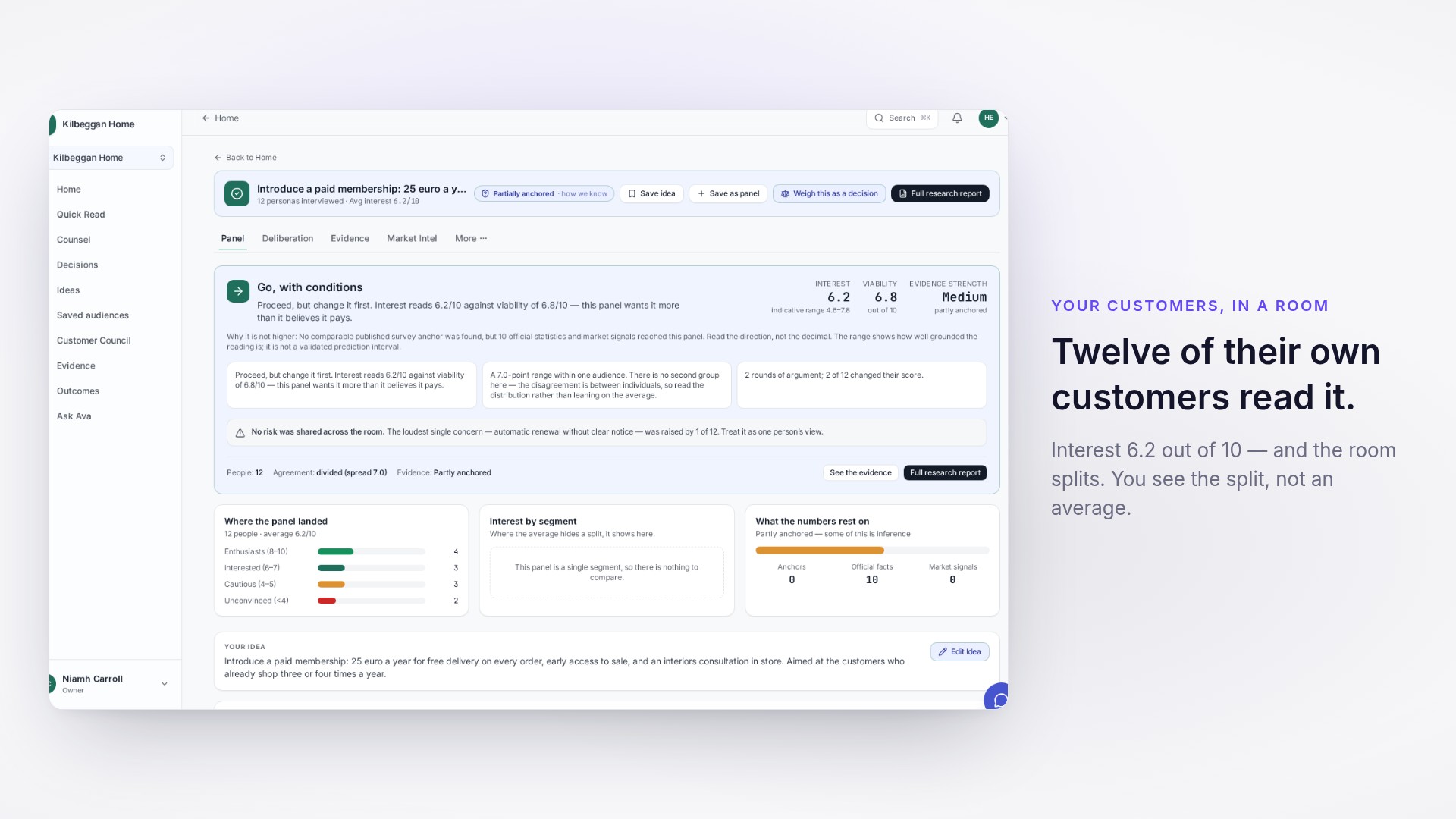
IllustrativeEach member carries the evidence they were built from and how far that evidence reaches. These are synthetic perspectives, not real respondents — they surface objections and disagreement, they do not measure behaviour.
- SarahResistant
Recently switched · Price-sensitive
“I moved because you were cheaper. If that disappears now, I'm comparing again.”
Based onAcquisition research · Recent churn · Competitor pricing
Evidence-backed - MichaelSupportive
Long-standing customer · Reliability-led
“I won't like the increase, but I'd rather pay a little more than risk unreliable service.”
Based onRetention history · Service research
Supported inference - AishaCautious
Digitally engaged · Value-conscious
“Explain what improves for me. A price increase without a benefit is difficult to justify.”
Based onCustomer survey · Product usage
Supported inference - DermotCautious
Small business account · Budget-fixed
“My budget is set annually. An 8% rise mid-year has to come out of something else.”
Based onAccount mix · CSO business costs
Synthetic interpretation
A number without a source is not evidence.
Outweigh preserves what kind of evidence something actually is, rather than letting it all blur into one persuasive answer.
Know what you know. Know what you're assuming.
- CRM
- Campaign performance
- Sales
- Complaints
- CSO
- ONS
- Eurostat
- Market research
- Outweigh analysis
- Decision Council response
Decision market: Ireland. Open any row to see the publication, period, retrieval date and why it was used.
Median household disposable income€48,240CSO · SILC
- Publication
- Central Statistics Office — Survey on Income and Living Conditions (SILC)
- Reference period
- 2024 (published 2025)
- Retrieved
- 12 August 2026
- Market relevance
- Ireland
- Why it was used
- Sets the income headroom a mid-year price increase has to fit inside for Irish households.
Average weekly household expenditure€992 / weekCSO · HBS
- Publication
- Central Statistics Office — Household Budget Survey
- Reference period
- 2022–2023
- Retrieved
- 12 August 2026
- Market relevance
- Ireland
- Why it was used
- Shows what a household already commits weekly, so the increase can be read as a share of committed spend.
Owner-occupied housing tenure68%CSO · Census
- Publication
- Central Statistics Office — Census of Population 2022, Housing
- Reference period
- Census 2022
- Retrieved
- 12 August 2026
- Market relevance
- Ireland
- Why it was used
- Tenure mix separates households with fixed housing costs from those exposed to rent movement.
UK regional gross weekly earnings (ONS · ASHE, 2025) — comparator only. Not used for the Irish market read.
- Supported
The increase is defensible where reliability is the reason to stay.
- Uncertain
Recently acquired, price-led customers may re-enter the market.
- Repeated objection
“What improves for me?” — raised by three of four council members.
- Needs testing
A benefit-paired increase against a bare increase, before rollout.
A first council and brief typically comes back in minutes.
Enterprise infrastructure. One question.
What are you working on today?
No configuration, no persona builder, no survey design. Everything underneath assembles from the decision itself.
For the organisation making the decision — and the advisers guiding it.
In-house teams
For the people accountable for pricing, proposition, campaign and retention calls — and for the record those calls leave behind.
- Every important customer decision preserved in one place
- Your own material sits alongside verified market evidence
- Predictions frozen before the outcome, then scored against it
- An error band that belongs to your organisation, not a vendor claim
- A record the board and the team can revisit years later
After a handful of decisions, you stop asking whether the platform is accurate in general and start reading how accurate it has been for you.
Consultants and advisory firms
One decision method across every engagement, with a measured accuracy statement you can defend in the room.
- Separate, isolated client workspaces
- Client-ready decision briefs and board reports
- A reusable, repeatable decision method
- A defensible accuracy statement to put in front of a client
- Decision history that survives staff turnover
- Evidence-backed Decision Councils per engagement
Your judgement remains the differentiator. Outweigh does the evidence organisation, customer synthesis and decision administration underneath it.
Talk to us about a practice licenceWhat it is, and what it isn't.
A chat assistant and a decision record are different things.
A general assistant can answer the question. It is the handling of the answer afterwards that differs.
- A chat assistant
One blended answer, in one confident voice.
OutweighDistinct perspectives that are required to disagree and to name what they are missing.
- A chat assistant
Everything in the answer sounds equally certain.
OutweighEach figure is labelled: observed internally, official statistic, inference, or synthetic interpretation.
- A chat assistant
The answer isn't kept, so it is never checked.
OutweighThe prediction is frozen before the result is known, then scored against what happened.
- A chat assistant
A conversation that ends when the tab closes.
OutweighA decision record the organisation keeps, with the error band published.
- A structured way to challenge an important customer decision before you act.
- A record of the evidence, assumptions and reasoning behind that decision.
- A scored prediction — frozen first, compared with the outcome afterwards.
- A like-for-like comparison of several options, judged by one panel on the same evidence.
- A way to decide what is genuinely worth testing with real customers.
- Synthetic perspectives are not real customer respondents.
- Outweigh does not replace customer research.
- Council responses are interpretations, not measured behaviour.
- The accuracy figures are error bands, not guarantees.
The things people ask first.
- How is accuracy measured?
- Every published figure comes from a blind, single-pass run against cases with outcomes already on the public record. Grounding is cut off at the decision date, the prediction is frozen in an immutable snapshot before the observed value is read, and misses stay in the set. On 48 fresh post-cutoff public-survey questions the mean absolute error is 12.6 points; on 19 commercial Irish and British outcomes it is 8.7 points. The full protocol and every case is published on the calibration page.
- Why can't our team just do this in ChatGPT, Claude or Copilot?
- You can get a useful answer from any of them, and they can be given your files and some memory. Three things are different here. A general assistant tends to agree with the person asking, where a Decision Council is built to disagree and to say what it is missing. It blends every input into one confident voice, where Outweigh keeps the kinds of evidence apart — what was observed internally, what comes from official statistics, what is inference and what is synthetic interpretation. And it does not keep the prediction, so nobody ever finds out how wrong it was; here the prediction is frozen before the result is known and scored against what happened, with the measured error published on the calibration page.
- Can it compare several options rather than test one idea?
- Yes. Two to eight options — creatives, price points, propositions — are put to the same panel on the same evidence, so the difference is the option and not the room. The board is ranked with the reasoning and the pushback for each, and where the gap is narrower than our measured error the platform says the two cannot be separated and names what would separate them. Ranking accuracy has not yet been measured, so no ranking figure is claimed.
- How is this different from synthetic persona tools?
- A persona tool produces an answer and stops. Outweigh preserves the decision, freezes the prediction, records the outcome and measures the error — so how far off it has been on your own decisions is a matter of record rather than an impression. Once enough of your own outcomes are recorded, a correction drawn only from that client's history can be applied, and both the raw and corrected numbers are printed. We do not claim accuracy improves automatically with volume.
- Are these real people?
- No. The Decision Council is a set of distinct synthetic perspectives representing the people affected by a decision, grounded where relevant in your evidence and official statistics for the market you name. It surfaces objections and disagreement; it does not measure real behaviour.
- Where is our data stored?
- In the EU. The platform database is hosted in Ireland. Uploaded material is held in private storage and served through short-lived signed links.
- Can a consultant use it across several clients?
- Yes. Each client organisation's decisions, evidence and councils are isolated from the others — including from the platform's own assistant.
- How long does a decision take to run?
- A first council and decision brief typically comes back in minutes, so a decision can be pressure-tested inside the meeting that raised it.
- Does this replace customer research?
- No. It sharpens it — use it before research to decide what is worth asking, and after research to test how a decision may land.
A small Irish company, with its working shown.
Outweigh is built and operated by Probity Net Limited, registered in Ireland. We are new, we hold no security certifications, and we are not going to pretend otherwise. What we offer instead is evidence you can check before you buy: the accuracy protocol and every scored case, a tenant-isolation test report, a data processing agreement, and a completed security questionnaire your client's reviewer can read.
A wrong pricing call costs six figures. Testing it costs a fraction of that.
Outweigh is an annual licence from €12,000 with unlimited decisions — priced against the exposure of the decisions you bring, not against a seat count.
See how the price is justifiedBring us one real decision.
We'll frame it, ground it, freeze the prediction and give you the record. It becomes the first entry in something your organisation keeps.